Saturday, 29 April 2017

Prescription Generic Medicine

The Prime Minister’s announcement that prescription of medicines by their generic names will be mandatory has set the cat among the pigeons. It is not a well-thought-out move and diverts attention from the real crisis in public health and the lack of access to quality, affordable medicines for all.
At least 90% of the Indian domestic pharmaceutical market, of ₹1,00,000 crore and more, comprises drugs sold under brand names. There simply are not enough generic name equivalents of branded medicines sold. About half the market—₹50,000 crore and more—is for fixed-dose combinations (FDCs) of drugs, a further half of them irrational. Many FDC drugs contain even eight or nine medicines. To write, and remember, the constituents of FDC drugs in generic names is impractical, considering that there would be thousands of FDC brands.
Even if the doctor manages to write a prescription in generic names for single-ingredient drugs, pharmacists will sell the brand that maximises their commission and will in all likelihood not stock the less costlier but equivalent brand or generic medicine that is as good. This defeats the basic intention of making medicines affordable for consumers. Prescription by generic names merely shifts the focus of the pharmaceutical industry’s unethical drug promotion to the pharmacist; away from the prescriber, and resulting in business as usual. Medicines will continue to account for anything from 50% to 80% of treatment costs.
The Government of India has championed setting up Jan Aushadhis, which are pharmacies selling only generic name medicines to the extent possible, giving preference to pharmaceutical public sector undertakings (PSUs) too. There are not enough Jan Aushadhis, possibly less than 3,000 against the more than eight lakh retail pharmacies in existence, with many rural areas still underserved.
To facilitate Jan Aushadhis, the Drugs Technical Advisory Board (DTAB) in May 2016 considered amending Rule 65 (11A) of the Drugs and Cosmetics Act, 1940 so that pharmacists can dispense generic name medicines and/or equivalent brands against prescriptions in brand names. The DTAB rejected the idea citing that the bioavailability of a generic drug may not be as good as that of the prescribed brand. (Bioavailability is a measurement of the extent of a therapeutically active medicine that reaches the systemic circulation and is therefore available at the site of action; whereas bioequivalence is the comparison of the bioavailability of two medicines, say the generic drug and the branded drug.) This means that the government’s top decision-making body on medicine-related matters does not have confidence in the products manufactured by the government’s own PSUs. The DTAB, however, could have recommended biowaivers on bioavailability/bioequivalence (BA/BE) for certain classes of drugs based on their permeability and solubility, a practice followed in countries where healthcare is well regulated. BA/BE studies are essential for certain critical dose drugs and drugs of narrow therapeutic range, which are few in number.
By implication, the DTAB has doubts that generic name medicines in general can have acceptable BA/BE at all. Probably, the DTAB is not confident that India’s regulatory agencies can strictly enforce quality requirements.
The Tamil Nadu and Rajasthan governments procure generic name medicines at extremely competitive prices year after year, and crores of drugs are in use in their public health systems, thanks to the quality assurance systems in place. The success of the drug procurement system in these two states should counter the defeatist narrative that insists that generic medicines can never be good. This is not to underestimate the challenges in ensuring quality generic medicines countrywide, but the critics from the medical profession are doing the poor patient enormous disservice by swallowing the disinformation from the pharmaceutical industry about the general lack of bioavailability of generics as compared to brands.
The Medical Council of India (MCI), in an amendment to the Code of Conduct for doctors in October 2016, has recommended that every physician “should prescribe drugs with generic names legibly … and he/she shall ensure that there is a rational prescription and use of drugs.” How the MCI is going to ensure rational prescription and use, without a framework to measure the same, is anybody’s guess.
Rational use and prescription depends on the doctor, the pharmacist, the regulator, and the consumer. Some minimum prerequisites for rational use are: prescription-only medicines (Schedules G, H, H1 and X) must not be available freely over the counter; doctors and their professional bodies along with regulators must ensure there is no misuse of antibiotics and critical drugs; and the removal of all irrational/harmful/useless medicines, both FDCs and unscientific single ingredients, must be ensured. Practical guidelines for rational use and prescription audit of medicines must be developed and implemented seriously by all doctors. Branding of off-patent drugs needs to be discouraged as is the practice in well-regulated countries. The Hathi Committee Report (1975) too had recommended debranding.
Price control of an enlarged list of essential and life-saving drugs is a must as was mandated by the Supreme Court in 2003. The current market-based price mechanism of the Drug Price Control Order (DPCO) 2013 is a travesty and has resulted in ceiling prices that allow 2,000% to 3,000% (and in some cases, 10,000%) margins. This needs to be replaced by the cost-plus method of ceiling price fixation of the DPCO 1995.
The number one priority must, thus, be the replication of the Tamil Nadu/Rajasthan model of free medicines in all states, and pharmaceutical PSUs must be re-energised and reinvented instead of the government disinvesting in them.

Saturday, 18 March 2017

Glossary for Clinical research,pharmacovigilance,Clinical Trails,

1.1 Adverse Drug Reaction (ADR)
In the pre-approval clinical experience with a new medicinal product or its new usages, particularly as the therapeutic dose(s) may not be established: all noxious and unintended responses to a medicinal product related to any dose should be considered adverse drug reactions. The phrase responses to a medicinal product means that a causal relationship between a medicinal product and an adverse event is at least a reasonable possibility, i.e. the relationship cannot be ruled out.
Regarding marketed medicinal products: a response to a drug which is noxious and unintended and which occurs at doses normally used in man for prophylaxis, diagnosis, or therapy of diseases or for modification of physiological function (see the ICH Guideline for Clinical Safety Data Management: Definitions and Standards for Expedited Reporting).
1.2 Adverse Event (AE)
Any untoward medical occurrence in a patient or clinical investigation subject administered a pharmaceutical product and which does not necessarily have a causal relationship with this treatment. An adverse event (AE) can therefore be any unfavourable and unintended sign (including an abnormal laboratory finding), symptom, or disease temporally associated with the use of a medicinal (investigational) product, whether or not related to the medicinal (investigational) product (see the ICH Guideline for Clinical Safety Data Management: Definitions and Standards for Expedited Reporting).
1.3 Amendment to the protocol
See Protocol Amendment.
1.4 Applicable Regulatory Requirement(s) 
Any law(s) and regulation(s) addressing the conduct of clinical trials of investigational products.
1.5 Approval (in relation to Institutional Review Boards)
The affirmative decision of the IRB that the clinical trial has been reviewed and may be conducted at the institution site within the constraints set forth by the IRB, the institution, Good Clinical Practice (GCP), and the applicable regulatory requirements.
1.6 Audit
A systematic and independent examination of trial related activities and documents to determine whether the evaluated trial related activities were conducted, and the data were recorded, analyzed and accurately reported according to the protocol, sponsor’s standard operating procedures (SOPs), Good Clinical Practice (GCP), and the applicable regulatory requirement(s).
1.7 Audit Certificate
A declaration of confirmation by the auditor that an audit has taken place.
1.8 Audit Report
A written evaluation by the sponsor’s auditor of the results of the audit.
1.9 Audit Trail
Documentation that allows reconstruction of the course of events.
1.10 Blinding/Masking
A procedure in which one or more parties to the trial are kept unaware of the treatment assignment(s). Single-blinding usually refers to the subject(s) being unaware, and double-blinding usually refers to the subject(s), investigator(s), monitor, and, in some cases, data analyst(s) being unaware of the treatment assignment(s).
1.11 Case Report Form (CRF)
A printed, optical, or electronic document designed to record all of the protocol required information to be reported to the sponsor on each trial subject.
1.12 Clinical Trial/Study
Any investigation in human subjects intended to discover or verify the clinical, pharmacological and/or other pharmacodynamic effects of an investigational product(s), and/or to identify any adverse reactions to an investigational product(s), and/or to study absorption, distribution, metabolism, and excretion of an investigational product(s) with the object of ascertaining its safety and/or efficacy. The terms clinical trial and clinical study are synonymous.
1.13 Clinical Trial/Study Report
A written description of a trial/study of any therapeutic, prophylactic, or diagnostic agent conducted in human subjects, in which the clinical and statistical description, presentations, and analyses are fully integrated into a single report (see the ICH Guideline for Structure and Content of Clinical Study Reports).
1.14 Comparator (Product)
An investigational or marketed product (i.e., active control), or placebo, used as a reference in a clinical trial.
1.15 Compliance (in relation to trials)
Adherence to all the trial-related requirements, Good Clinical Practice (GCP) requirements, and the applicable regulatory requirements.
1.16 Confidentiality
Prevention of disclosure, to other than authorized individuals, of a sponsor’s proprietary information or of a subject’s identity.
1.17 Contract
A written, dated, and signed agreement between two or more involved parties that sets out any arrangements on delegation and distribution of tasks and obligations and, if appropriate, on financial matters. The protocol may serve as the basis of a
contract.
1.18 Coordinating Committee
A committee that a sponsor may organize to coordinate the conduct of a multicentre trial.
1.19 Coordinating Investigator
An investigator assigned the responsibility for the coordination of investigators at different centres participating in a multicentre trial.
1.20 Contract Research Organization (CRO)
A person or an organization (commercial, academic, or other) contracted by the sponsor to perform one or more of a sponsor’s trial-related duties and functions.
1.21 Direct Access
Permission to examine, analyze, verify, and reproduce any records and reports that are important to evaluation of a clinical trial. Any party (e.g., domestic and foreign regulatory authorities, sponsor’s monitors and auditors) with direct access should
take all reasonable precautions within the constraints of the applicable regulatory requirement(s) to maintain the confidentiality of subjects’ identities and sponsor’s proprietary information.
1.22 Documentation
All records, in any form (including, but not limited to, written, electronic, magnetic, and optical records, and scans, x-rays, and electrocardiograms) that describe or record the methods, conduct, and/or results of a trial, the factors affecting a trial, and the
actions taken.
1.23 Essential Documents
Documents which individually and collectively permit evaluation of the conduct of a study and the quality of the data produced (see 8. Essential Documents for the Conduct of a Clinical Trial).
1.24 Good Clinical Practice (GCP)
A standard for the design, conduct, performance, monitoring, auditing, recording, analyses, and reporting of clinical trials that provides assurance that the data and reported results are credible and accurate, and that the rights, integrity, and confidentiality of trial subjects are protected.
Monitoring Board, Monitoring Committee, Data Monitoring Committee) An independent data-monitoring committee that may be established by the sponsor to assess at intervals the progress of a clinical trial, the safety data, and the critical efficacy endpoints, and to recommend to the sponsor whether to continue, modify, or stop a trial.
1.26 Impartial Witness
A person, who is independent of the trial, who cannot be unfairly influenced by people involved with the trial, who attends the informed consent process if the subject or the subject’s legally acceptable representative cannot read, and who reads the informed
consent form and any other written information supplied to the subject.
1.27 Independent Ethics Committee (IEC)
An independent body (a review board or a committee, institutional, regional, national, or supranational), constituted of medical professionals and non-medical members, whose responsibility it is to ensure the protection of the rights, safety and well-being
of human subjects involved in a trial and to provide public assurance of that protection, by, among other things, reviewing and approving / providing favourableopinion on, the trial protocol, the suitability of the investigator(s), facilities, and the methods and material to be used in obtaining and documenting informed consent of the trial subjects.
The legal status, composition, function, operations and regulatory requirements pertaining to Independent Ethics Committees may differ among countries, but should allow the Independent Ethics Committee to act in agreement with GCP as described in this guideline.
1.28 Informed Consent
A process by which a subject voluntarily confirms his or her willingness to participate in a particular trial, after having been informed of all aspects of the trial that are relevant to the subject’s decision to participate. Informed consent is documented by
means of a written, signed and dated informed consent form.
1.29 Inspection
The act by a regulatory authority(ies) of conducting an official review of documents, facilities, records, and any other resources that are deemed by the authority(ies) to be related to the clinical trial and that may be located at the site of the trial, at the sponsor’s and/or contract research organization’s (CRO’s) facilities, or at other establishments deemed appropriate by the regulatory authority(ies).
1.30 Institution (medical)
Any public or private entity or agency or medical or dental facility where clinical
trials are conducted.
1.31 Institutional Review Board (IRB)
An independent body constituted of medical, scientific, and non-scientific members, whose responsibility is to ensure the protection of the rights, safety and well-being of human subjects involved in a trial by, among other things, reviewing, approving, and
providing continuing review of trial protocol and amendments and of the methods and material to be used in obtaining and documenting informed consent of the trial subjects.
1.32 Interim Clinical Trial/Study Report
A report of intermediate results and their evaluation based on analyses performed during the course of a trial.
1.33 Investigational Product
A pharmaceutical form of an active ingredient or placebo being tested or used as a reference in a clinical trial, including a product with a marketing authorization when used or assembled (formulated or packaged) in a way different from the approved form, or when used for an unapproved indication, or when used to gain further information about an approved use.
1.34 Investigator
A person responsible for the conduct of the clinical trial at a trial site. If a trial is conducted by a team of individuals at a trial site, the investigator is the responsible leader of the team and may be called the principal investigator. See also Subinvestigator.
1.35 Investigator / Institution
An expression meaning “the investigator and/or institution, where required by the applicable regulatory requirements”.
1.36 Investigator’s Brochure
A compilation of the clinical and nonclinical data on the investigational product(s) which is relevant to the study of the investigational product(s) in human subjects (see 7. Investigator’s Brochure).
1.37 Legally Acceptable Representative
An individual or juridical or other body authorized under applicable law to consent, on behalf of a prospective subject, to the subject’s participation in the clinical trial.
1.38 Monitoring
The act of overseeing the progress of a clinical trial, and of ensuring that it is conducted, recorded, and reported in accordance with the protocol, Standard Operating Procedures (SOPs), Good Clinical Practice (GCP), and the applicable regulatory requirement(s).
1.39 Monitoring Report
A written report from the monitor to the sponsor after each site visit and/or other trial-related communication according to the sponsor’s SOPs.
1.40 Multicentre Trial
A clinical trial conducted according to a single protocol but at more than one site, and therefore, carried out by more than one investigator.
1.41 Nonclinical Study
Biomedical studies not performed on human subjects.
1.42 Opinion (in relation to Independent Ethics Committee)
The judgement and/or the advice provided by an Independent Ethics Committee (IEC).
1.43 Original Medical Record
See Source Documents.
1.44 Protocol
A document that describes the objective(s), design, methodology, statistical considerations, and organization of a trial. The protocol usually also gives the background and rationale for the trial, but these could be provided in other protocol referenced documents. Throughout the ICH GCP Guideline the term protocol refers to protocol and protocol amendments.
1.45 Protocol Amendment
A written description of a change(s) to or formal clarification of a protocol.
1.46 Quality Assurance (QA)
All those planned and systematic actions that are established to ensure that the trial is performed and the data are generated, documented (recorded), and reported in compliance with Good Clinical Practice (GCP) and the applicable regulatory requirement(s).
1.47 Quality Control (QC)
The operational techniques and activities undertaken within the quality assurance system to verify that the requirements for quality of the trial-related activities have been fulfilled.
1.48 Randomization
The process of assigning trial subjects to treatment or control groups using an element of chance to determine the assignments in order to reduce bias.
1.49 Regulatory Authorities
Bodies having the power to regulate. In the ICH GCP guideline the expression Regulatory Authorities includes the authorities that review submitted clinical data and those that conduct inspections (see 1.29). These bodies are sometimes referred to as competent authorities.
1.50 Serious Adverse Event (SAE) or Serious Adverse Drug Reaction
(Serious ADR)
Any untoward medical occurrence that at any dose:
- results in death,
- is life-threatening,
- requires inpatient hospitalization or prolongation of existing hospitalization,
- results in persistent or significant disability/incapacity,
or
- is a congenital anomaly/birth defect
(see the ICH Guideline for Clinical Safety Data Management: Definitions and Standards for Expedited Reporting).
1.51 Source Data
All information in original records and certified copies of original records of clinical findings, observations, or other activities in a clinical trial necessary for the reconstruction and evaluation of the trial. Source data are contained in source documents (original records or certified copies).
1.52 Source Documents
Original documents, data, and records (e.g., hospital records, clinical and office charts, laboratory notes, memoranda, subjects’ diaries or evaluation checklists, pharmacy dispensing records, recorded data from automated instruments, copies or
transcriptions certified after verification as being accurate copies, microfiches, photographic negatives, microfilm or magnetic media, x-rays, subject files, and records kept at the pharmacy, at the laboratories and at medico-technical departments involved in the clinical trial).
1.53 Sponsor
An individual, company, institution, or organization which takes responsibility for the initiation, management, and/or financing of a clinical trial.
1.54 Sponsor-Investigator
An individual who both initiates and conducts, alone or with others, a clinical trial, and under whose immediate direction the investigational product is administered to, dispensed to, or used by a subject. The term does not include any person other than
an individual (e.g., it does not include a corporation or an agency). The obligations of a sponsor-investigator include both those of a sponsor and those of an investigator.
1.55 Standard Operating Procedures (SOPs)
Detailed, written instructions to achieve uniformity of the performance of a specific function.
1.56 Subinvestigator
Any individual member of the clinical trial team designated and supervised by the investigator at a trial site to perform critical trial-related procedures and/or to make important trial-related decisions (e.g., associates, residents, research fellows). See also
Investigator.
1.57 Subject/Trial Subject
An individual who participates in a clinical trial, either as a recipient of the investigational product(s) or as a control.
1.58 Subject Identification Code
A unique identifier assigned by the investigator to each trial subject to protect the subject’s identity and used in lieu of the subject’s name when the investigator reports adverse events and/or other trial related data.
1.59 Trial Site
The location(s) where trial-related activities are actually conducted.
1.60 Unexpected Adverse Drug Reaction
An adverse reaction, the nature or severity of which is not consistent with the applicable product information (e.g., Investigator’s Brochure for an unapproved investigational product or package insert/summary of product characteristics for an approved product) (see the ICH Guideline for Clinical Safety Data Management: Definitions and Standards for Expedited Reporting).
1.61 Vulnerable Subjects
Individuals whose willingness to volunteer in a clinical trial may be unduly influenced by the expectation, whether justified or not, of benefits associated with participation, or of a retaliatory response from senior members of a hierarchy in case of refusal to participate. Examples are members of a group with a hierarchical structure, such as medical, pharmacy, dental, and nursing students, subordinate hospital and laboratory personnel, employees of the pharmaceutical industry, members of the armed forces, and persons kept in detention. Other vulnerable subjects include patients with incurable diseases, persons in nursing homes, unemployed or impoverished persons, patients in emergency situations, ethnic minority groups, homeless persons, nomads, refugees, minors, and those incapable of giving consent.
1.62 Well-being (of the trial subjects)
The physical and mental integrity of the subjects participating in a clinical trial.

Thursday, 16 March 2017

Pharma news: Hidden killer in your cold meds

Pharma news: Hidden killer in your cold meds

Hidden killer in your cold meds

Dear flocks 
Most people hear "over the counter" and think "safe." If you can buy it at your local drugstore without a prescription, it must be okay to take, right?
Not so fast…
Taking popular OTC cold medicines can actually raise your risk of heart attack.
By now you probably know that taking NSAIDs (nonsteroidal anti-inflammatory drugs) can be bad news for your heart.
In fact, the FDA actually boosted label warnings on NSAIDs in 2015 to say they can increase the risk of heart attack or stroke.
Now a recent study discovered that patients who are suffering from a common cold or flu are also at greater risk.
And when you take NSAIDs while you have a cold or the flu, you triple your chance of having a heart attack.1
When you have even a mild illness — like a cold or sinus infection — your body produces inflammatory proteins and thickens your blood. That can result in blood clots.
Taking NSAIDs not only causes your blood pressure to go up, it can also cause your blood platelets to clump together and may constrict your blood vessels.
Put them together and your risk for heart attack skyrockets… you're at 3.5 times greater risk than when you're healthy and not taking NSAIDs.
This is concerning because many OTC cold and flu medications contain NSAIDs. Because they can help with fever and pain, they're commonly added to many well-known cold and flu remedies.
I tell my patients to leave these dangerous medications on the shelf and take a walk in the sunshine instead.
A new study published in the British Medical Journal backs up what I've been saying for years — a daily dose of vitamin D can prevent millions of people a year from coming down with colds and flu.
This landmark study included over 11,000 patients. It found that among patients with the lowest levels of vitamin D, supplementation reduced their risk for acute respiratory infection by half.2
I encourage my patients to keep their levels in the range of 40 to 60 ng/mL. You can ask your doctor for a simple blood test if you don't know what yours are.
Sun exposure is the most natural and effective way to make sure your vitamin D levels are where they need to be. But gloomy winter weather and the epidemic use of sunblock means up to 58% of all Americans are deficient in vitamin D.3
If you can, spend at least 15-20 minutes outside every day. Make sure to uncover parts of your body that aren't normally exposed to sunlight.
Wear a hat to protect the delicate skin on your face, but bare your legs, torso or back… anyplace that isn't typically exposed.
The farther north you are from the equator — or the bleaker your winter weather — the more sun you need. If it's not practical to spend enough time in the sunlight every day (making sure not to burn), you should consider supplementing.
Vitamin D supplements are available as vitamin D2 (ergocalciferol) or D3 (cholecalciferol). Make sure to take vitamin D3 because vitamin D2 breaks down rapidly in your body.4
I recommend 5,000 IU of vitamin D3 every day.
To Your Good Health,

Monday, 14 November 2016

Effects of Maternal Age and Age-Specific Preterm Birth Rates on Overall Preterm Birth Rates — United States, 2007 and 2014


    Reductions in births to teens and preterm birth rates are two recent public health successes in the United States (1,2). From 2007 to 2014, the birth rate for females aged 15–19 years declined 42%, from 41.5 to 24.2 per 1,000 females. The preterm birth rate decreased 8.4%, from 10.41% to 9.54% of live births (1). Rates of preterm births vary by maternal age, being higher among the youngest and oldest mothers. It is unknown how changes in the maternal age distribution in the United States have affected preterm birth rates. CDC used birth data to assess the relative contributions of changes in the maternal age distribution and in age-specific preterm birth rates to the overall decrease in preterm birth rates. The preterm birth rate declined in all age groups. The effects of age distribution changes on the preterm birth rate decrease were different in younger and older mothers. The decrease in the proportion of births to mothers aged ≤19 and 20−24 years and reductions in age-specific preterm rates in all age groups contributed to the overall decline in the preterm birth rate. The increase in births to mothers aged ≥30 years had no effect on the overall preterm birth rate decrease. The decline in preterm births from 2007 to 2014 is related, in part, to teen pregnancy prevention and the changing maternal age distribution. Effective public health strategies for further reducing preterm birth rates need to be tailored to different age groups.

     National Vital Statistics System data for all live births to U.S. residents in 2007 and 2014 were analyzed for the effects of maternal age on the decline in preterm birth rates. The analysis was limited to births with gestational age ≥20 weeks, as determined by the obstetric estimate. The year 2007 was the first year the obstetric estimate was available nationally (1,3). The year 2014 was the most recent year with final birth data available at the time of analysis. Preterm birth rates were defined as <37 completed weeks of gestation and expressed as a percentage of live births. Maternal age was categorized as ≤19, 20−24, 25−29, 30−34, and ≥35 years. Using rate decomposition methods, the change in preterm birth rates from 2007 to 2014 was divided into two components: 1) changes in the maternal age distribution, and 2) changes in the age-specific preterm birth rates (4). The two components were calculated relative to each other; one was held constant (by using the average value for the 2 years) as the observed variation in the other component was assessed. The sum of the two components across the age groups equaled the total preterm birth rate difference (4).
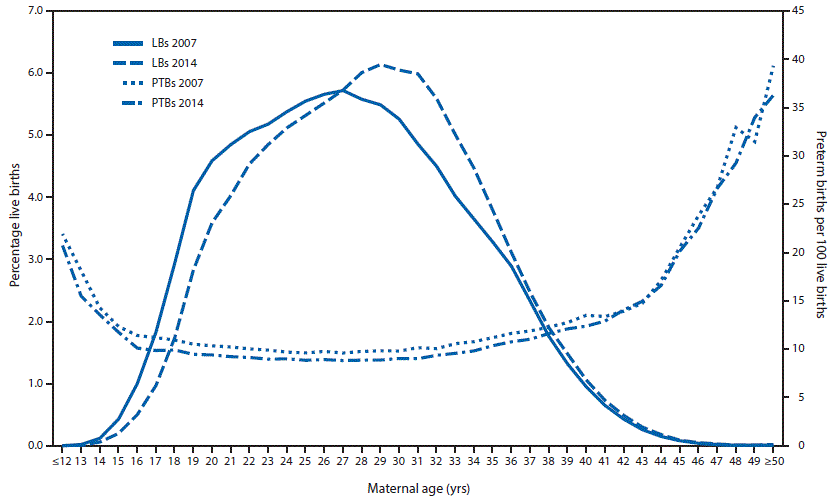
From 2007 to 2014, maternal age increased from a mean of 27.4 years to 28.3 years (Figure). A decrease in the percentage of births to mothers aged ≤24 years was observed, which included a 39.5% decrease in births to teens and an increase in births to women aged ≥25 years (Table).
From 2007 to 2014, the preterm birth rate decreased from 10.41% to 9.54%, an absolute rate difference of -0.87% (Table). A U-shaped relationship between maternal age and preterm birth was present in both years with the lowest preterm birth rate occurring among women aged 25−29 years (Table) (Figure). The decrease in preterm birth rates from 2007 to 2014 was observed for mothers at all ages <42 years. The absolute rate difference was highest among teens and lowest among women aged ≥35 years (Table).

   The decomposition analysis partitioned the overall observed rate difference of -0.87% into two parts, age distribution and age-specific rate components (Table). The change in age distribution contributed to the preterm birth rate decrease (as indicated by the negative values) only among mothers aged ≤24 years. In contrast, the age distribution component for mothers aged ≥25 years, and especially for mothers aged ≥30 years, offset this decline. When the age distribution components were summed across the age groups, a negligible effect (0.01) was observed on the overall change in preterm birth rates. The change in age-specific preterm birth rates contributed to the decline in preterm birth rate across all age groups.

    Examining the total effect of both components on the preterm birth rate decline by age group, the largest total effects were observed among mothers aged ≤19 and mothers aged 20−24 years (Table). In these two groups, the change in age distribution had a larger effect than the change in the age-specific preterm birth rate. For mothers aged 25−29 years, the total effect also contributed to the overall preterm birth rate decline because the age-specific rate component was greater than the age distribution component. For mothers aged ≥30 years, the total effect of both components did not contribute to the overall preterm birth rate decrease; the rate increases from the age distribution components were greater than the rate decreases from the age-specific rate components.
These analyses included all births; however, sensitivity analyses restricting to singleton births produced similar results. The overall absolute rate difference for singletons during this period was -0.85%, compared with the -0.87% for all births.

Discussion

     The overall decline in the preterm birth rate from 2007 to 2014 was related to declines in age-specific preterm birth rates and a decrease in prevalence of births to teens and women aged 20−24 years. The contribution from mothers aged ≥24 years to the age-distribution component was offset by an increased prevalence of births to older mothers who have high rates of preterm birth. Thus, the total age distribution component masked divergent influences of younger and older mothers on the overall preterm birth rate decline. Because of this, the influence of younger mothers on the overall preterm birth rate decline is more appropriately indicated by examining the age-specific total effects in the decomposition analysis. Considering relative effects of both age distribution and age-specific preterm birth rate components, only mothers aged ≤29 years contributed to the overall rate decline, with the largest contributions from teens and women aged 20−24 years.

   Other studies have documented increased preterm birth rates among teen and older mothers compared with mothers in their mid-twenties to early thirties. Although teen and older mothers might share some common preterm birth risk factors, such as low socioeconomic status, extremes of body mass index, and smoking, physiologic immaturity is a risk factor for teen mothers and the prevalence of preexisting chronic disease is greater among older mothers. This heterogeneity of risk for preterm births according to maternal age and the variation in changes in age-specific preterm birth rates, combined with the changes in maternal age distribution over time, suggest the need for varying preterm birth prevention strategies across the reproductive life span.
The findings in this report are subject to at least one limitation: the relationship of preterm birth with maternal age is associative, not causal. The analysis did not assess the impact of other pregnancy outcomes, such as elective termination or fetal death, or of potential confounders, such as maternal race/ethnicity, obstetric history, smoking, socioeconomic status, body mass index, chronic or pregnancy-related conditions, prenatal care, and delivery method. The effects on preterm birth rates of maternal 17-hydroxyprogesterone use, a preterm birth prevention strategy that increased during this period , were not examined and the effects of maternal age on spontaneous, medically indicated, early, or late preterm births were not assessed.
The overall decline in the preterm birth rate from 2007 to 2014 is related in part to the changing maternal age distribution associated with the success of teen pregnancy prevention and declines in unintended pregnancy. Teen pregnancy prevention is one of CDC’s Winnable Battles . Although teen pregnancy prevention and family planning have many positive health and societal effects, the results of this analysis suggest these programs might also have direct effects on reducing preterm birth rates. Based on recent data, 75% of pregnancies to teens aged 15−19 years and 59% of pregnancies to women aged 20−24 years are unintended . The need for prevention of first and repeat teen pregnancies continues. Prevention of unintended pregnancy and encouragement of optimal birth spacing is one part of a five-part strategy for preterm birth prevention. Other strategies include improved access to preconception care, preterm birth risk identification and treatment, reduction of elective delivery before 39 weeks gestation, and single embryo transfer in assisted reproductive technology. These strategies need to be implemented throughout the reproductive life span to reduce preterm births for all maternal ages.

 FIGURE. Percentages of live births (LBs) and preterm births (PTBs), by maternal age —United States, 2007 and 2014
                         

November is National Prematurity Awareness Month

In 2016, about 1 in 10 babies was born too early in the United States. Learn about the problem, risk factors, and what we can do to reduce premature birth.


About Premature Birth

A developing baby goes through important growth throughout pregnancy—including in the final months and weeks. Premature (also known as preterm) birth is when a baby is born too early, before 37 weeks of pregnancy have been completed. The earlier a baby is born, the higher the risk of death or serious disability. In 2015, preterm birth and low birth weight accounted for about 17% of infant deaths. Babies who survive can have breathing issues, intestinal (digestive) problems, and bleeding in their brains. Long-term problems may include developmental delay (not meeting the developmental milestones for his or her age) and lower performance in school.

Preterm Birth in the United States


Reducing preterm birth is a national public health priority. Preterm birth rates decreased from 2007 to 2014, and CDC research shows the decline in preterm births is partly due to fewer teens and young women giving birth. Despite this success, the preterm birth rate rose for the second straight year in 2016, and about 1 in 10 babies (10%) was born too early in the United States. Additionally, racial and ethnic differences in preterm birth rates remain. For example, in 2016, the rate of preterm birth among non-Hispanic black women (14%) was about 50% higher than the rate of preterm birth among non-Hispanic white women (9%).

Risk Factors

Experts don’t know all the reasons that some babies are born too early. Some things (called risk factors) can increase the chance that a woman will have a preterm birth. However, a woman can still have a premature birth even if she has no known risk factors.
Risk factors for preterm birth include—
  • Health behaviors
    • Tobacco use
    • Alcohol or drug abuse
  • Medical and pregnancy characteristics
    • Mental health (stress, depression)
    • Pregnancy history (short time between pregnancies, delivering a baby preterm in the past, being pregnant with multiples)
    • Pregnancy complications (preeclampsia, placenta previa or placental abruption)
    • Medical disorders (thyroid disease, obesity, asthma, diabetes, high blood pressure)
    • Fertility treatments (assisted reproductive technology or other treatments)
    • Infection within the uterus


Saturday, 12 November 2016

Novel Drug Delivery Systems Yie Chien


A comprehensive treatment of the science, technology, and regulation of rate-controlled administration

 of therapeutic agents, with coverage of the basic concepts, fundamental principles, biomedical 

rationales, and potential applications. This revised and updated edition (first in 1982) incorporates


                                                      click me